Why Global Supply Chains Are Shifting, How to Navigate the Market.
Introduction: The Global Shift is Underway
For the last two decades, the answer to “Where should I buy fasteners?” was almost always China. But the world has changed. Between geopolitical tensions, fluctuating tariffs, and supply chain instability, global procurement managers are scrambling for a “China Plus One” strategy.
Enter India.
India is no longer just a backup option; it is rapidly becoming the primary hub for high-tensile and precision fasteners. With access to premium raw steel (Tata, JSW), a skilled English-speaking workforce, and massive government infrastructure investment, India is ready.
But sourcing from a new country can be daunting. How do you find reliable manufacturers? What about customs? How do you ensure the steel quality?
This guide covers everything you need to know to successfully import industrial fasteners from India.
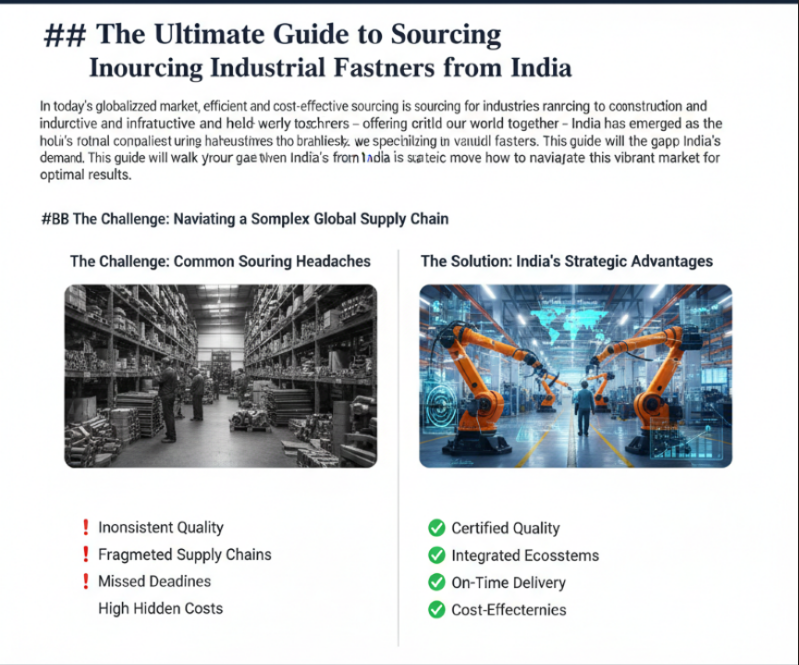
The Challenge: Navigating a Complex Global Supply Chain
International buyers often face significant hurdles when sourcing industrial fasteners:
Part 1: Why the World is shifting to India (The “Why”)
It’s not just about price anymore; it’s about stability.
- Raw Material Integrity: India is the world’s second-largest steel producer. Unlike some regions that rely on scrap metal recycling (which can lead to impurities), Indian manufacturers have direct access to high-grade virgin steel from giants like Tata Steel and JSW.
- No Language Barrier: India is the second-largest English-speaking country in the world. Engineering drawings, technical specs, and contract negotiations happen seamlessly in English, eliminating the costly “lost in translation” errors common in other markets.
- Geopolitical Stability: India offers a stable democratic environment with friendly trade relations with the USA, Europe, and the Middle East, reducing the risk of sudden sanction-based supply shocks.
Caption: India’s strategic location offers direct sea connectivity to major global ports like Hamburg, New York, and Jebel Ali.
Part 2: The Sourcing Checklist (The “How”)
Before you sign a contract, you need to vet your potential partner. Here is the checklist professional buyers use.
1. Verify the “Mill to Machine” Traceability
Don’t just ask for a finished bolt; ask where the steel came from.
- The Red Flag: A supplier who cannot tell you the specific steel mill heat number.
- The Green Light: A supplier who provides a Mill Test Certificate (MTC) that traces the metal back to the original steel plant.
2. Audit the “In-House” Capabilities
Many “manufacturers” are actually just traders who buy from small workshops and re-sell.
- Ask for: Photos or video calls of their specific machinery—headers, thread rollers, and most importantly, their Quality Lab.
- Why: If they don’t have a spectrometer or tensile testing machine on-site, they are guessing on quality.
3. Inspect the Packaging Standards
The ocean is cruel to steel. “Container Rain”—condensation inside shipping containers—can rust an entire shipment before it arrives.
- Requirement: Demands export-grade wooden crates (fumigated) with VCI (Volatile Corrosion Inhibitor) lining or desiccants inside the box.
Caption: Proper export packaging is the only line of defense against saltwater corrosion.
Part 3: Logistics & Customs Cheat Sheet
Importing doesn’t have to be a headache if you have the right paperwork.
Common HS Codes for Fasteners:
- 7318.15: Bolts and Screws (Iron/Steel)
- 7318.16: Nuts
- 7318.22: Washers
The “Must-Have” Document Packet:
- Commercial Invoice: Detailed breakdown of costs.
- Packing List: Net weight, gross weight, and crate count.
- Bill of Lading (BL): Your proof of ownership.
- Certificate of Origin: often required to claim reduced import duties (depending on your country’s trade agreement with India).
- MTC (Mill Test Certificate): The technical proof of quality.
Part 4: How Seven Horses International Solves the “Trust Gap”
n today’s globalized market, efficient and cost-effective sourcing is paramount for industries ranging from construction and infrastructure to automotive and heavy machinery. When it comes to industrial fasteners – the critical components that hold our world together – India has emerged as a powerhouse, offering a compelling blend of quality, capacity, and competitive pricing.
At Seven Horses International, we specialize in bridging the gap between India’s robust manufacturing capabilities and global demand. This guide will walk you through why sourcing industrial fasteners from India is a strategic move and how to navigate this vibrant market for optimal results.
We built Seven Horses International to bridge the gap between Indian manufacturing excellence and global buying standards. We know that you aren’t just buying a bolt; you are buying trust.
Here is our promise to you:
- The “No-Surprise” Policy: We are the eyes and ears on the ground. We personally inspect raw material heat numbers before production begins.
- The Lab-Backed Guarantee: We don’t ship without testing. Every batch passes through our internal lab for tensile strength and chemical analysis.
- Seamless Logistics: From the factory floor in India to your warehouse door, we handle the complexity of documentation and freight.