How to choose the right coating for your project, prevent catastrophic failure, and why “shiny” doesn’t always mean “strong.”
The Hidden Cost of the Wrong Choice
Corrosion isn’t just an eyesore; it’s a financial disaster waiting to happen. Did you know that corrosion costs the global economy over $2.5 trillion annually?
For a procurement manager or project engineer, the nightmare scenario is simple: You specify a fastener for a solar farm or a bridge. Two years later, the bolts are seizing up with red rust. Maintenance costs skyrocket, and your reputation takes a hit.
The problem? One size does not fit all.
A coating that works perfectly for a car engine (Zinc Flake/Geomet) might be a disaster for a marine dock (HDG). And a coating that looks beautiful on a shelf (Zinc Plated) might dissolve in weeks outdoors.
At Seven Horses International, we believe in engineering the right solution for your environment. Here is the definitive breakdown of the three titans of fastener coatings: Zinc Plating, Hot Dip Galvanizing, and Geomet.
1. Zinc Plating (Electro-Galvanized)
The “Indoor” Standard
Zinc plating is the most common fastener coating in the world. It involves using an electrical current to deposit a thin layer of zinc onto the steel surface.
- The Look: Bright, shiny, silver/blue (or yellow chromate). It has excellent “shelf appeal.”
- The Performance: It provides a basic sacrificial barrier. However, the coating is extremely thin (typically 3–12 microns).
- The Limit: It is not designed for harsh outdoor environments. In a Salt Spray Test (SST), standard white zinc often shows white rust in just 24–96 hours.
- Best For: Indoor furniture, electronics, automotive interior parts, and dry environments.
Pro Tip: Never use standard Zinc Plated bolts for critical outdoor infrastructure. They will rust.
2. Hot Dip Galvanizing (HDG)
The “Heavyweight Champion”
If Zinc Plating is a light raincoat, Hot Dip Galvanizing is a suit of armor. In this process, fasteners are dipped into a bath of molten zinc at 450°C (840°F).
- The Look: Dull, matte gray. The finish is rough and inconsistent compared to plating.
- The Performance: Massive protection. The zinc forms a metallurgical bond with the steel, creating a coating that is often 40–80+ microns thick. It offers cathodic protection—meaning if the coating is scratched, the surrounding zinc sacrifices itself to save the steel.
- The Critical Challenge: The coating is so thick that standard nuts won’t fit. You must use nuts that are “tapped oversize” to accommodate the extra layer of zinc.
- Best For: Transmission towers, highway guardrails, construction, and marine environments.
3. Geomet (Zinc Flake Coating)
The “High-Tech” Performer
Geomet (a brand of Zinc Flake coating) is the modern answer to high-performance demands. It uses zinc and aluminum flakes dissolved in a solvent, applied via a dip-spin process, and baked onto the fastener.
- The Look: Matte silver-gray (cleaner looking than HDG).
- The Performance: Incredible protection with a very thin layer. A thin 8-micron layer of Geomet can often outlast 50 microns of HDG in salt spray tests (often hitting 1000+ hours).
- The “Secret Weapon” (Hydrogen Embrittlement): This is vital for high-strength bolts (Grade 10.9 or 12.9).
- The Risk: Acid cleaning in Zinc/HDG can introduce hydrogen into the steel, causing high-tensile bolts to crack internally.
- The Solution: Geomet is an acid-free process, eliminating the risk of hydrogen embrittlement.
- Best For: Automotive chassis, wind turbines, and high-tensile structural bolts (10.9/12.9).
The Decision Matrix: Compare at a Glance
Stop guessing. Use this table to match the coating to your project needs.
| Feature | Zinc Plated (White/Blue) | Hot Dip Galvanized (HDG) | Geomet (Zinc Flake) |
| Typical Thickness | 3 – 12 Microns (Thin) | 40 – 85 Microns (Thick) | 8 – 12 Microns (Thin) |
| Salt Spray Life (SST) | 24 – 96 Hours | 500 – 1000+ Hours | 1000 – 1500+ Hours |
| Process Temp | Cold (Electrolytic) | Hot (~450°C) | Warm Cure (~300°C) |
| Hydrogen Embrittlement Risk | HIGH (Requires baking) | HIGH (Acid pickling risk) | ZERO (Safe for Grade 12.9) |
| Thread Fit | Perfect | Requires Oversize Nuts | Good |
| Cost | Low | Medium | High |
For global buyers in construction, marine, infrastructure, or any industry where fasteners face harsh environmental conditions, choosing the right protective coating is as crucial as selecting the right material. When your fasteners embark on a long journey across the ocean, or are destined for corrosive outdoor applications, the coating becomes their first, and often last, line of defense against rust. The two most common choices are Zinc Plating and Hot Dip Galvanizing (HDG).
At Seven Horses International, we understand the critical difference these coatings make. This guide will help you navigate the complexities, ensuring your fasteners arrive, and remain, uncompromised, even after surviving the brutal gauntlet of ocean freight.
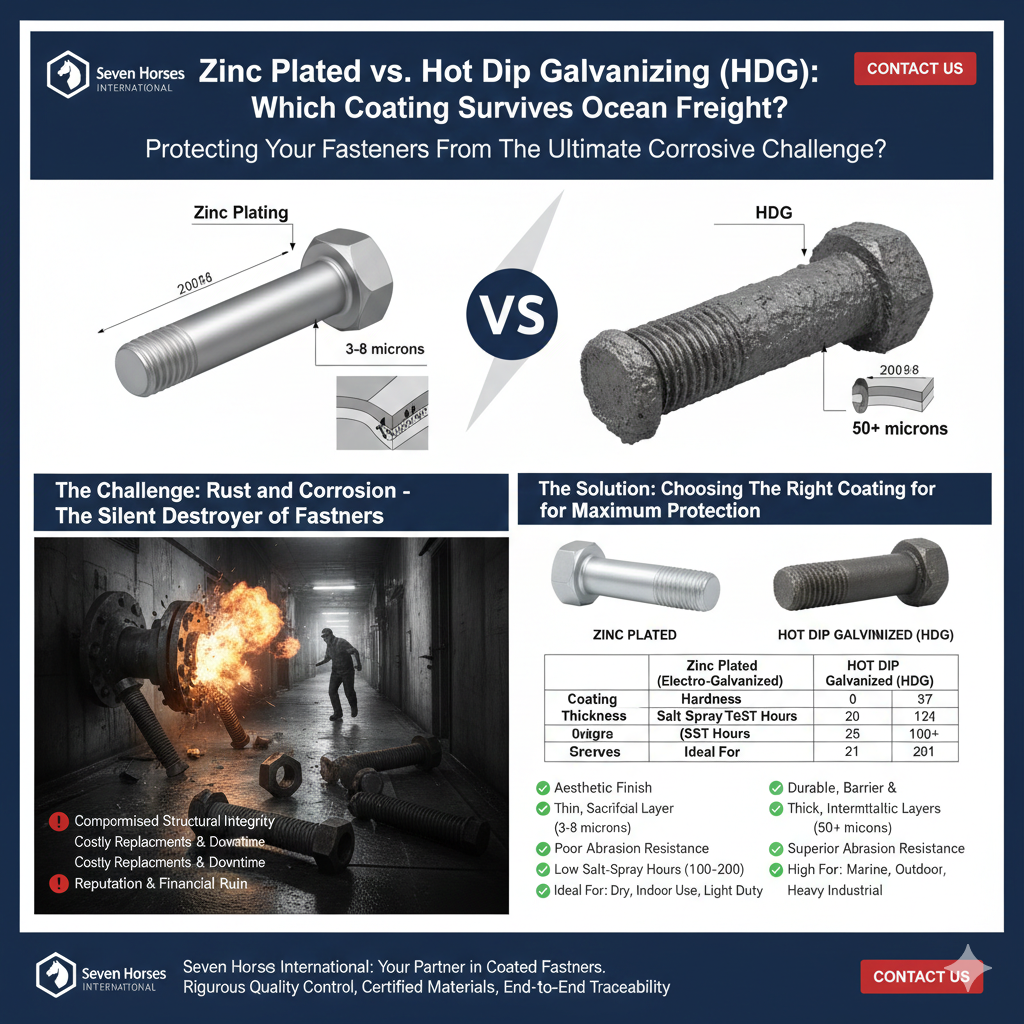
Zinc Plated vs. Hot Dip Galvanizing (HDG): Which Coating Survives Ocean Freight? Protecting Your Fasteners From The Ultimate Corrosive Challenge
For global buyers in construction, marine, infrastructure, or any industry where fasteners face harsh environmental conditions, choosing the right protective coating is as crucial as selecting the right material. When your fasteners embark on a long journey across the ocean, or are destined for corrosive outdoor applications, the coating becomes their first, and often last, line of defense against rust. The two most common choices are Zinc Plating and Hot Dip Galvanizing (HDG).
At Seven Horses International, we understand the critical difference these coatings make. This guide will help you navigate the complexities, ensuring your fasteners arrive, and remain, uncompromised, even after surviving the brutal gauntlet of ocean freight.
The Challenge: Rust and Corrosion – The Silent Destroyer of Fasteners
Imagine receiving a shipment of fasteners, only to find them already marred by rust, even before installation. Or worse, witnessing premature corrosion of critical components just months after deployment in a marine environment.
The Challenge: Rust and Corrosion – The Silent Destroyer of Fasteners
Imagine receiving a shipment of fasteners, only to find them already marred by rust, even before installation. Or worse, witnessing premature corrosion of critical components just months after deployment in a marine environment.
How Seven Horses International Ensures You Get What You Pay For
The global market is flooded with “fake” coatings—fasteners that look like Geomet but are just silver paint, or “HDG” bolts that are barely thicker than zinc plating.
At Seven Horses International, we function as your technical firewall against low quality.
1. We Verify the Microns
We use digital coating thickness gauges on every batch. If you order HDG, we guarantee the ASTM A153 minimum (usually 43-53 microns depending on size). You get a report proving it.
2. The Salt Spray Chamber Test
We don’t guess lifespan; we prove it.
- We can run localized Salt Spray Tests (SST) to verify that your batch meets the required hours (e.g., 720 hours red rust-free) before it ever gets loaded onto a ship.
3. Thread Fitment Guarantees
Nothing is worse than a nut that won’t spin. For our HDG orders, we meticulously check the thread fit of the oversized nuts after galvanizing to ensure smooth assembly on your job site.
The Bottom Line
- Building a warehouse indoors? Save money with Zinc Plated.
- Building a dock or solar farm? Rely on the thick armor of HDG.
- Building a car or wind turbine? Invest in the precision of Geomet.
Don’t let corrosion eat your profits. Partner with an exporter who understands the chemistry behind the hardware.
Contact Seven Horses International today for a technical consultation on your next project’s coating requirements.