Why ASTM A193 B7 Threaded Rods Are the Backbone of Heavy Industry
In the demanding worlds of oil & gas, petrochemical, and heavy construction, fasteners are not merely components; they are critical links that ensure safety, structural integrity, and operational longevity. Among the vast array of industrial fasteners, ASTM A193 B7 threaded rods stand out as a cornerstone for high-temperature and high-pressure applications. At Seven Horses International, we understand that for global buyers, specifying and sourcing the correct B7 threaded rod is paramount. This guide will demystify B7, explain its importance, and illustrate why it’s a non-negotiable choice for your most critical projects.
Whether you are an engineer designing a pressure vessel or a procurement manager looking to source High Tensile Studs, understanding the mechanics and sourcing realities of B7 rods is critical. Here is everything you need to know.
What is an ASTM A193 B7 Threaded Rod?
The ASTM A193 specification covers alloy and stainless steel bolting materials tailored for high-temperature or high-pressure service. The “B7” grade specifically refers to fasteners made from Chromium-Molybdenum (Chromoly) steel—typically AISI 4140 or 4142.
To achieve its legendary strength, the raw steel undergoes a rigorous heat-treatment process: it is quenched in oil and then tempered at a specific temperature (minimum 1150°F / 620°C). This process aligns the molecular structure of the steel, providing the perfect balance of extreme hardness and the ductility required to stretch without snapping.
The Technical Edge: Mechanical Properties of B7
Why do engineers specifically write “B7” into their blueprints? It comes down to the numbers. The mechanical properties of a fastener dictate how much load it can bear before it permanently deforms (Yield Strength) or breaks entirely (Tensile Strength).
Here is the critical data you need for standard B7 threaded rods (for diameters 2½ inches and under):
| Property | Minimum Requirement | What It Means for You |
| Tensile Strength | 125,000 psi (125 ksi) | The maximum amount of pulling stress the rod can withstand before failing. |
| Yield Strength | 105,000 psi (105 ksi) | The exact point where the rod will bend or stretch and not return to its original shape. |
| Elongation | 16% | A measure of ductility; how much the material can stretch before breaking, preventing sudden, brittle snapping. |
| Hardness | 321 HBW / 35 HRC (Maximum) | Ensures the surface is hard enough to resist wear and maintain thread integrity under heavy torque. |
The Challenge: Fastener Failure in Extreme Environments
Imagine a flange connection in a refinery operating under immense pressure and extreme temperatures, or a critical structural support in a power plant. What happens if the threaded rod holding these components together fails? The consequences can be catastrophic:
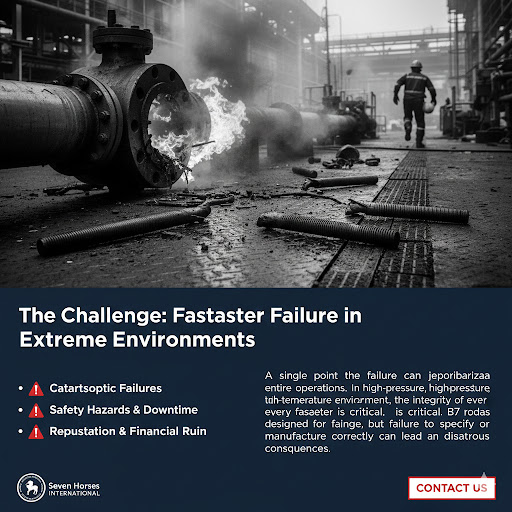
- Catastrophic Failures: Structural collapse, pipeline ruptures, or equipment malfunction.
- Safety Hazards & Downtime: Risk to personnel, costly operational stoppages, and lost production.
- Reputational & Financial Ruin: Legal liabilities, insurance claims, and irreparable damage to your brand.
A single point of failure can jeopardize entire operations. In high-pressure, high-temperature environments, the integrity of every fastener is critical. B7 threaded rods are specifically designed to prevent these failures, but to specify and manufacture them correctly requires deep expertise.
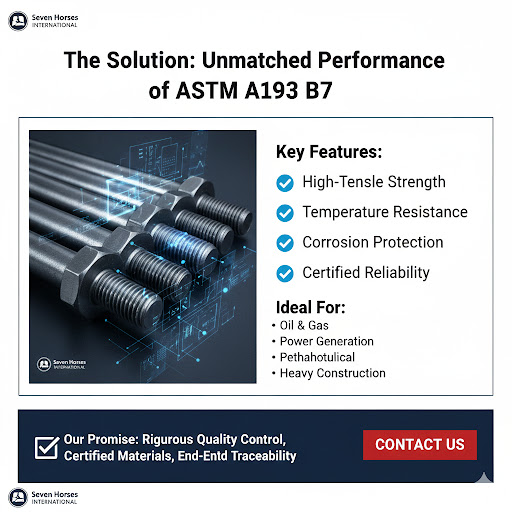
The Solution: The Unmatched Performance of ASTM A193 B7 Threaded Rods
ASTM A193 Grade B7 specifies alloy steel bolts and studs for high-temperature or high-pressure service. This material is renowned for its exceptional strength, temperature resistance, and durability, making it the industry standard for demanding applications.
Enter Seven Horses International: Your Trusted Sourcing Partner
At Seven Horses International, we don’t just export fasteners; we export peace of mind. We understand that when you order ASTM A193 B7 Threaded Rods, you are trusting us with the safety of your infrastructure.
Here is how we eliminate your sourcing risks:
1. We Don’t Guess; We Test (In-House Quality Assurance)
We know that in your industry, trust is built on data. Every batch of B7 rods we produce is backed by rigorous testing.
(Insert your previously generated image of the Indian workers in the Quality Assurance Lab here)
- Spectrometer Analysis: Verifying the exact chemical composition (Chromium & Molybdenum levels).
- Universal Testing Machines (UTM): Physically stretching the rods to guarantee they meet the 125 ksi Tensile and 105 ksi Yield strength requirements.
2. Export-Grade Packaging (Zero Transit Damage)
A perfectly manufactured thread is useless if it gets dented in a shipping container. At Seven Horses International, we treat packaging with the same precision as manufacturing.
(Insert your previously generated image of the export packaged threaded rods on the forklift here)
We use heavy-duty, reinforced wooden crates specifically designed for international sea freight. The rods are securely bundled, wrapped to prevent moisture corrosion (rust), and locked in place. When the container arrives at your facility in the USA, Europe, or the Middle East, the rods are in the exact pristine condition as when they left our factory.
Ready to Secure Your Supply Chain?
Stop gambling with unverified suppliers. Partner with a B7 Rod Manufacturer in India that prioritizes precision, transparent testing, and secure logistics.