By Laksh Ahuja / January 18, 2026
Introduction
Pipe support assemblies for oil and gas facilities play an important role in maintaining the stability, alignment, and reliability of industrial piping systems. From pipe clamps and structural brackets to threaded rods, channels, beam clamps, and fastening hardware, every component needs to be selected according to the application and operating environment.
Oil and gas facilities operate under demanding conditions, including temperature changes, vibration, mechanical loading, corrosion, and continuous operation. A properly selected pipe support system helps keep piping securely positioned while accommodating the requirements of the overall piping design.
At Seven Horses International, we understand that sourcing pipe support components is not simply about finding a product that fits a particular pipe. International buyers need consistent manufacturing quality, appropriate materials, reliable documentation, and dependable supply.
Why Are Pipe Supports Important in Oil and Gas Facilities?
Piping systems in refineries, petrochemical plants, terminals, processing facilities, and other industrial installations can cover significant distances and carry fluids under demanding operating conditions.
The support system helps manage the weight of:
- Pipes
- Valves
- Flanges
- Fittings
- Insulation
- Fluid inside the pipe
- Other connected components
The support arrangement may also need to account for thermal movement, vibration, equipment connections, structural loads, and the specific requirements of the piping system.
For process piping applications, ASME B31.3 is an important reference. ASME states that B31.3 covers piping typically found in petroleum refineries, chemical plants, power generation and related processing facilities, including requirements concerning materials, components, design, fabrication, assembly, examination, inspection, and testing. (ASME)
Important: The applicable standard and design requirements should always be determined from the project’s engineering specifications and the relevant codes for that installation.
The Problem: When Pipe Support Systems Are Poorly Selected
Imagine an oil and gas facility where a process pipeline has been installed with support components that were incorrectly specified or poorly matched to the application.
The problem may not be immediately visible.
Once the system begins operating, however, the piping can experience:
- Thermal expansion and contraction
- Vibration
- Mechanical loads
- Wind forces
- Fluid movement
- Changes in operating temperature
- Corrosive environmental conditions
An inadequate support arrangement can contribute to unwanted pipe movement, excessive loads, vibration, alignment issues, and maintenance difficulties.
Real-World Impact
Pipe Movement:
Insufficient or incorrectly positioned supports can allow unwanted movement or displacement.
Excessive Stress:
Improper support locations can transfer unwanted loads into piping and connected equipment.
Vibration:
Poorly secured piping can experience excessive movement and vibration during operation.
Corrosion:
Inappropriate materials or surface finishes can reduce service life in corrosive environments.
Maintenance Problems:
Poorly designed or difficult-to-access support assemblies can make inspection and maintenance more complicated.
Project Delays:
Incorrect components can result in rework, replacement requirements, and installation delays.
This makes pipe support selection an important part of the overall piping and structural design process.
Choosing the Right Pipe Support Assembly
Selecting pipe support assemblies for oil and gas facilities requires more than simply matching the pipe diameter.
The complete assembly should be considered according to the pipe, loading conditions, support structure, operating environment, material requirements, and project specifications.

1. Pipe Clamps
Pipe clamps are used to secure pipes to supporting structures and are available in different configurations depending on the installation.
Applications may include:
- Horizontal pipe supports
- Vertical pipe supports
- Suspended piping
- Insulated piping
- Industrial process piping
- Heavy-duty applications
The clamp should be appropriately matched to the pipe outside diameter, expected loading, installation configuration, and environmental conditions.
Material selection is also important. Carbon steel, stainless steel, and corrosion-protected finishes may be used depending on the application.
2. Pipe Brackets and Structural Channels
Pipe brackets and structural channels create the framework used to support piping.
Channel systems can be particularly useful where several pipes need to be supported from a common structure or where adjustable support configurations are required.
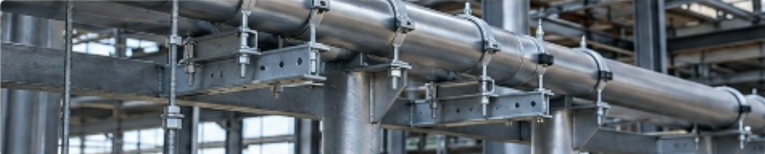
When selecting channels and brackets, buyers should consider:
- Required load capacity
- Pipe arrangement
- Span
- Structural attachment
- Installation space
- Material
- Surface finish
- Environmental exposure
The support structure should be designed according to the actual loading and engineering requirements rather than selected solely on the basis of physical appearance.
3. Threaded Rods
Threaded rods are commonly incorporated into suspended pipe support assemblies.
They can connect pipe clamps, channels, brackets, and other support components to structural members.
Important specifications can include:
- Diameter
- Length
- Material
- Thread type
- Thread pitch
- Strength/grade
- Surface finish
- Corrosion resistance
For industrial applications, carbon steel, galvanized steel, and stainless steel threaded rods may be considered depending on project requirements.
The correct specification should be established from the engineering design and customer requirements.
4. Beam Clamps and Structural Connections
Beam clamps can provide a practical connection between pipe support assemblies and structural steel members without requiring additional welded connections in certain applications.
They may be used together with:
- Threaded rods
- Pipe clamps
- Strut channels
- Brackets
- Nuts and washers
The beam clamp must be selected according to the structural member, loading requirements, installation configuration, and applicable engineering specifications.
Material Selection for Oil and Gas Pipe Supports
Material selection is particularly important when purchasing pipe support assemblies for oil and gas facilities.
Industrial environments may expose support components to:
- Moisture
- Salt
- Chemicals
- High temperatures
- Outdoor weather
- Corrosive atmospheres

Common material and finish options can include:
| Material / Finish | Typical consideration |
|---|---|
| Carbon Steel | General industrial applications |
| Hot-Dip Galvanized Steel | Improved corrosion protection |
| Zinc-Plated Steel | Indoor/general applications where suitable |
| Stainless Steel | Corrosive or demanding environments |
| Special Coatings | Project-specific corrosion requirements |
The correct material should always be selected according to the environment, expected service life, project specification, and engineering requirements.
Standards and Engineering Requirements
There is no single standard that automatically applies to every pipe support component used in every oil and gas project.
The applicable requirements can depend on:
- Pipe size
- Operating temperature
- Pressure
- Fluid service
- Materials
- Structural design
- Facility type
- Country of installation
- Client specifications
For process piping, ASME B31.3 is one important reference for applicable systems. (ASME)
Other standards may apply to specific components or parts of the overall system. For example, ASME B16.5 covers pipe flanges and flanged fittings and addresses areas including pressure-temperature ratings, materials, dimensions, tolerances, marking, and testing. (ASME)
For this reason, buyers should provide suppliers with the relevant:
- Engineering drawings
- Material specifications
- Product specifications
- Applicable standards
- Inspection requirements
- Quality requirements
This helps prevent incorrect substitutions and specification mismatches.
What Should Buyers Look for in a Pipe Support Supplier?
Selecting a reliable manufacturer or exporter can be just as important as selecting the component itself.
A capable supplier should be able to provide:
Consistent Manufacturing Quality
Products should be manufactured consistently according to agreed dimensions, materials, tolerances, and specifications.
Material Documentation
Where required by the project, appropriate material certificates and documentation should be available.
Dimensional Accuracy
Clamps, brackets, channels, threaded rods, nuts, and washers should be manufactured to work together correctly within the specified assembly.
Corrosion Protection
Surface treatments and finishes should be selected according to the intended environment and project requirements.
Inspection Support
For larger industrial projects, buyers may require inspection, testing, dimensional verification, or third-party inspection before shipment.
Reliable Delivery
Even relatively small support components can affect installation schedules when they are required in large quantities or are part of a critical construction package.
Why Reliable Manufacturing Partners Matter
A pipe support supplier is not simply providing pieces of steel.
They are becoming part of your supply chain.
For an international buyer, the supplier should ideally provide:
Product consistency → Quality documentation → Inspection support → Packaging → Export documentation → Reliable shipment
A weak link anywhere in that chain can create problems for the buyer.
This is particularly important when supplying components to large construction, EPC, oil and gas, petrochemical, and industrial projects.
Seven Horses International: Your Manufacturing & Export Partner
At Seven Horses International, we focus on connecting international buyers with capable manufacturing partners in India.
Our objective is to make industrial sourcing more straightforward by supporting customers through the manufacturing and export process.
How we can support your requirements
Vetted Manufacturing Network
We work with manufacturing partners capable of producing industrial components according to customer specifications.
Product & Specification Support
We help communicate requirements for dimensions, materials, finishes, packaging, and other technical specifications.
Quality Coordination
Production can be coordinated according to agreed inspection and quality requirements.
Transparent Communication
Customers receive clear communication regarding production, documentation, inspection, and shipment status.
Export & Logistics Support
We support sourcing, production coordination, export documentation, and logistics.
Custom Requirements
Where manufacturing capability permits, we can coordinate products according to customer-specific dimensions and configurations.
Build Your Pipe Support Supply Chain With Confidence
The right pipe support assemblies for oil and gas facilities can help provide a reliable foundation for industrial piping installations.
From pipe clamps and brackets to threaded rods, channels, beam clamps, nuts, washers, and associated hardware, every component should be selected according to the requirements of the specific project.
For international buyers, the objective should not simply be to find the lowest-cost component.
It should be to find a reliable manufacturing and export partner capable of consistently supplying products to the required specification, quality level, documentation requirements, and delivery schedule.
Looking for Pipe Support Assemblies?
Seven Horses International can help you source pipe clamps, brackets, threaded rods, channels, beam clamps, and related industrial components from India.
Send us your drawings, specifications, quantities, or BOM and let our team help you identify suitable manufacturing options.
Contact Seven Horses International today to discuss your requirements.