Sourcing internationally offers incredible opportunities, but the logistics can be a minefield. Here is your essential guide to navigating the paperwork, costs, and physical risks of ocean freight so your goods arrive safely and on budget.
Introduction: The Hidden Challenge of Global Sourcing
You’ve found the perfect product. The quality is excellent, and the price is right. You are ready to place the order and grow your business.
But then the real questions begin:
- Who pays for the insurance if the ship sinks?
- Why is customs asking for a document you’ve never heard of?
- Will your metal components arrive rusted after 45 days on the salty ocean?
International trade is more than just buying and selling; it’s about moving goods across borders, oceans, and jurisdictions.
At Seven Horses International, we believe that logistics shouldn’t be a barrier to your success. A truly great export partner doesn’t just hand you the goods at their factory door and wish you luck. They guide you through the maze.
This article breaks down the three pillars of successful importing: Incoterms, Customs Documentation, and Ocean-Ready Packaging.
The Problem: Where International Orders Go Wrong
When buyers underestimate the complexity of logistics, the consequences are expensive and frustrating. We have seen countless examples where excellent products turned into a disaster due to logistical oversights:
- The Surprise Bill (Incoterm Confusion): A buyer thought “shipping included” meant delivery to their warehouse door. They were shocked to receive a massive bill for port handling charges, customs clearance, and local trucking at the destination because they misunderstood the Incoterm.
- The Customs Nightmare (Documentation Errors): A container sits held at a foreign port for three weeks, racking up daily storage fees (demurrage), all because a single digit was wrong on the HS Code on the Commercial Invoice.
- The “Container Rain” Disaster (Packaging Failure): A shipment of precision steel parts arrives. When the container doors open, everything is covered in rust. Why? The supplier didn’t account for temperature changes over the ocean causing condensation inside the container—known as “container rain.”
These aren’t bad luck; they are preventable errors.
The Solution: Your 3-Step Guide to Smooth Logistics
Step 1: Decoding Incoterms (Who Pays for What?)
Incoterms (International Commercial Terms) are three-letter codes published by the International Chamber of Commerce. They define exactly where the seller’s responsibility ends and the buyer’s begins regarding cost and risk.
While there are 11 Incoterms, these four are the most critical for importers to understand:
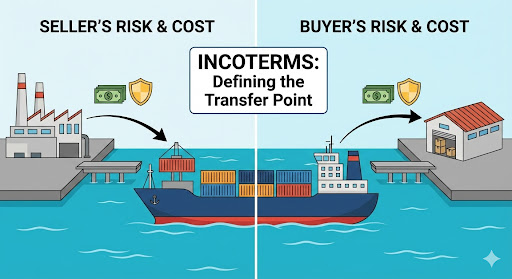
- EXW (Ex Works): The “DIY” option. The seller just makes the goods available at their factory. You arrange pickup, export clearance, ocean freight, insurance, and final delivery. Maximum control, maximum effort for the buyer.
- FOB (Free on Board): The industry standard. The seller gets the goods cleared for export and loaded onto the ship at the origin port. Once it crosses the ship’s rail, the risk and cost become yours.
- CIF (Cost, Insurance, Freight): The seller pays the ocean freight and basic insurance to your destination port. However, the risk transfers to you once the goods are on the ship at origin. You handle import clearance and final delivery.
- DDP (Delivered Duty Paid): The “concierge” service. The seller does everything, including paying import duties and taxes, delivering right to your door. (This is the most expensive option as the seller takes all the risk).
The Seven Horses Tip: We usually recommend FOB for experienced buyers who have their own freight forwarders, as it gives you control over shipping costs. For newer buyers, CIF can be easier as we handle the complex ocean journey for you.
Step 2: Mastering Customs Documentation (The Paper Trail)
Customs officials don’t care about your deadlines. They care about accurate paperwork. If the documents don’t match the cargo perfectly, your shipment stops moving.
These are the non-negotiables for ocean freight:
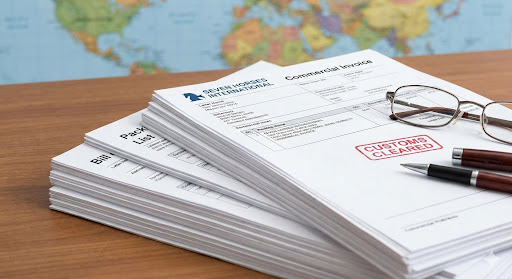
| Document | What it is & Why it’s Vital |
| Commercial Invoice | The “Bill.” It must show the exact value per unit, total value, currency, and Incoterm. Customs uses this to calculate duties. |
| Packing List | The “Inventory.” It details exactly how many boxes, weight (gross/net), and dimensions are in the shipment. It must match the physical cargo exactly. |
| Bill of Lading (B/L) | The “Ticket & Receipt.” This is the most important document. It proves ownership of the goods and acts as the contract with the shipping line. |
| Certificate of Origin (COO) | The “Passport.” Proves where the goods were made. This is crucial for claiming reduced duties under Free Trade Agreements between countries. |
Critical Focus: The HS Code. Every product has a Harmonized System code. Using the wrong code can lead to paying too much duty—or worse, heavy fines for misdeclaration.
Step 3: Safe Ocean Freight Packaging (Surviving the Journey)
The ocean is a hostile environment. Your goods will face constant vibration, stacking pressure from other pallets, and extreme humidity fluctuations. Standard domestic cardboard boxes will not survive.
At Seven Horses International, we treat packaging as an engineering challenge, not an afterthought.
Our Standard Protocol for Ocean Exports:
- ISPM-15 Heat-Treated Wood: All pallets and wooden crates must be heat-treated and stamped to prevent the spread of pests. Without this stamp, many countries will reject the entire shipment.
- VCI (Vapor Corrosion Inhibitor) Protection: For metal parts, we use VCI bags or paper. This releases invisible molecules that form a protective shield on metal surfaces, preventing rust even in humid salty air.
- Desiccants: We place oversized industrial silica gel bags inside the container to absorb moisture from the air and prevent “container rain.”
- Secure Stuffing & Lashing: Empty space in a container spells disaster. Cargo must be blocked and braced so it doesn’t shift during rough seas.
For international buyers, seamless delivery is as crucial as product quality. Unlock the complexities of global logistics to ensure your fastener shipments arrive on time, intact, and compliant, with Seven Horses International.
Introduction: The Invisible Bridges of Global Commerce
In the intricate world of international trade, a high-quality product is only half the equation. The journey from the manufacturer’s floor to your project site involves a complex web of regulations, responsibilities, and risks. Understanding Incoterms, customs documentation, and safe ocean freight packaging isn’t just about efficiency; it’s about minimizing costs, avoiding delays, and ensuring the integrity of your valuable fastener shipments.
For global buyers, navigating these logistical landscapes can be daunting. Errors can lead to significant financial penalties, extended transit times, and even damaged goods. At Seven Horses International, we don’t just supply superior fasteners; we provide a partnership that extends to mastering the intricacies of global logistics. This guide will clarify these essential components of successful international shipping.
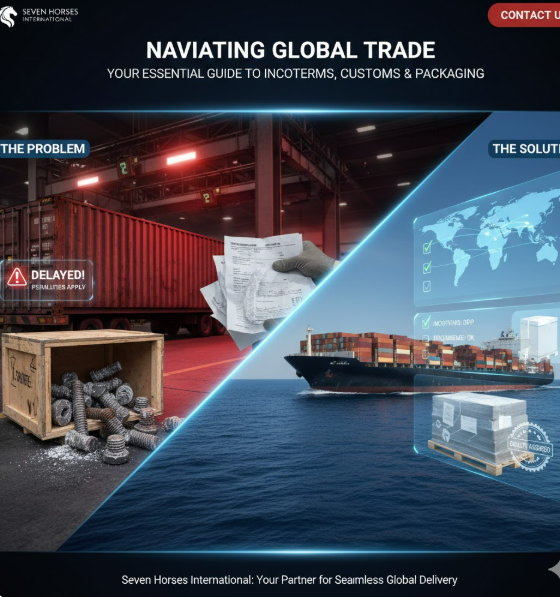
The Problem: When Logistical Lapses Lead to Costly Chaos
Missteps in international shipping can quickly turn a profitable order into a logistical nightmare:
- Unexpected Costs: Unclear Incoterms can saddle you with unforeseen duties, taxes, or freight charges.
- Customs Delays: Incomplete or incorrect documentation can halt your shipment at the border, leading to demurrage and project timeline disruptions.
- Damaged Goods: Improper packaging leaves high-value fasteners vulnerable to corrosion, impact, and loss during long ocean voyages.
- Legal & Compliance Risks: Non-compliance with international trade laws can result in fines or even seizure of goods.
Conclusion: Seven Horses International is Your Logistical Partner
Don’t let the fear of logistics stop you from accessing global markets. The key is not knowing everything yourself; it is choosing a supplier who understands the entire process.
At Seven Horses International, we don’t just manufacture products; we deliver solutions.
- We consult with you to choose the right Incoterm for your budget and experience level.
- Our export team meticulously triple-checks every document for accuracy before submission.
- Our warehouse team packages your goods to survive the toughest ocean journeys.
When you partner with us, you aren’t just buying goods. You are securing a seamless supply chain.
Are you ready to import with confidence? Contact our export specialists today to discuss your next project and let us handle the heavy lifting.