
In the world of critical fastening, a document can be as important as the bolt itself. Learn to expertly read MTCs and lab reports to ensure unwavering quality and compliance with Seven Horses International.
Introduction: The Unseen Assurance of Quality
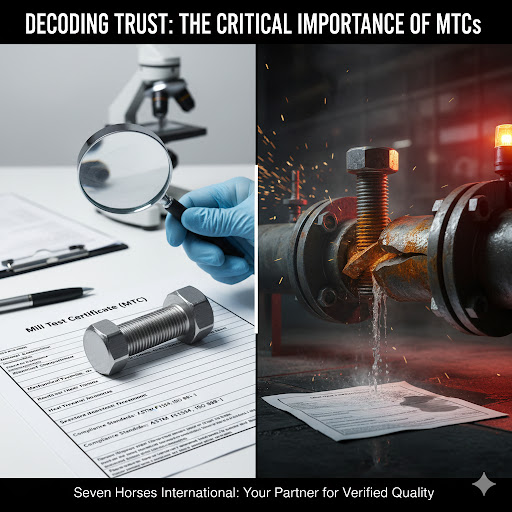
Every critical fastener, from a high-tensile bolt in a wind turbine to a corrosion-resistant stud in a chemical plant, carries more than just its physical properties. It carries a story – a meticulously documented journey from raw material to finished product, validated by a Mill Test Certificate (MTC), often supported by detailed lab reports.
For engineers and procurement professionals, an MTC isn’t just paperwork; it’s the passport of quality. It’s the definitive proof that a fastener meets the precise metallurgical, chemical, and mechanical specifications required for your project. Misinterpreting or overlooking these vital details can have severe consequences.
At Seven Horses International, we believe in complete transparency and empower our clients with the knowledge to demand and verify the highest quality. Let’s demystify these crucial documents.
The Problem: When Missing Details Lead to Major Risks
Without the ability to correctly interpret an MTC or lab report, you’re essentially buying blind. This can lead to:
- Substandard Materials: Receiving fasteners made from an inferior or incorrect grade that can’t withstand the intended operating conditions.
- Compliance Failure: Project rejection or legal liabilities due to fasteners not meeting required ASTM, DIN, or ISO standards.
- Safety Hazards: Components failing under stress, leading to equipment damage, injury, or even loss of life.
- Erosion of Trust & Costly Delays: Dispute resolution, re-ordering, and rework can significantly impact project timelines and budgets.
The Solution: A Step-by-Step Guide to MTC Mastery
A typical MTC (sometimes called a Material Test Report or MTR) contains several key sections. Here’s what to look for:
1. General Information & Identification
- Manufacturer & Supplier: Verify the origin of the material.
- Customer & Purchase Order (P.O.) No.: Ensures the MTC matches your specific order.
- Heat Number / Lot Number: This is crucial! It’s a unique identifier for the specific batch of raw material. All test results refer to this number, proving traceability.
- Material Specification: Clearly states the standard (e.g., ASTM A193 B7, ASTM F3125 Grade A325) and grade.
2. Chemical Composition
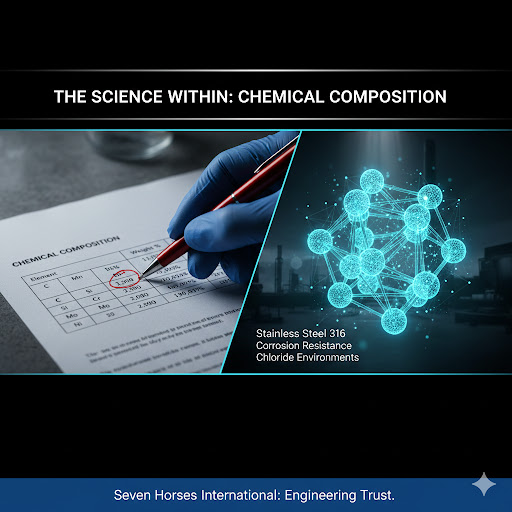
- Elemental Analysis: This section lists the percentage of key alloying elements (e.g., Carbon, Manganese, Silicon, Chromium, Molybdenum, Nickel) present in the material.
- Why it matters: These percentages must fall within the ranges specified by the standard. For example, the precise chromium and molybdenum content in Stainless Steel 316 is critical for its corrosion resistance. Any deviation could mean an incorrect or substandard material.
3. Mechanical Properties
This section verifies the material’s strength and ductility through rigorous testing.
- Tensile Strength (UTS): Maximum stress the material can withstand before fracturing.
- Yield Strength (YS): The stress at which the material begins to permanently deform.
- Elongation: A measure of ductility – how much the material can stretch before breaking.
- Reduction of Area: Another measure of ductility, indicating how much the cross-sectional area changes at the point of fracture.
- Hardness (e.g., Brinell, Rockwell): Resistance to indentation. For heat-treated materials like B7, this is a key indicator of proper processing.
- Impact Test (e.g., Charpy V-notch): For certain applications, this measures the material’s toughness and resistance to brittle fracture at specific temperatures.
- Why it matters: These values must meet or exceed the minimum requirements outlined in the material specification. For instance, ASTM A193 B7 requires a minimum tensile strength of 125 ksi.
4. Heat Treatment Details
- Type of Treatment: Specifies if the material was Quenched & Tempered, Annealed, Solution Annealed, etc.
- Temperature & Duration: Provides the critical parameters of the heat treatment process.
- Why it matters: Heat treatment fundamentally alters a fastener’s mechanical properties. Proper heat treatment is essential for achieving the required strength, hardness, and ductility for grades like B7 or certain Stainless Steels.
5. Additional Tests & Certifications
Depending on the specific requirements, an MTC might also include:
- Non-Destructive Testing (NDT): Ultrasonic Testing (UT), Magnetic Particle Testing (MPT), Liquid Penetrant Testing (LPT) to check for internal or surface flaws.
- Corrosion Resistance Tests: Salt spray tests, intergranular corrosion tests for stainless steels.
- Surface Finish/Coating Details: Confirmation of galvanization thickness, plating type, etc.
- Certification Statement: A declaration by the manufacturer or authorized agent that the material conforms to the specified standards.
This is a complete, professionally structured blog post designed for your export business. It addresses the anxieties of international buyers and positions Seven Horses International as a technically competent, trustworthy partner.
Global sourcing shouldn’t be a gamble. Learn to decode the most critical document in international trade to ensure you get the quality you paid for.
The Paper That Proves the Product
Imagine ordering a high-strength alloy steel bolt for a critical infrastructure project. It arrives looking shiny and perfect. But how do you know it won’t snap under pressure? You can’t tell the steel grade just by looking at it.
In the world of international trade—especially when importing steel, fasteners, and industrial components from hubs like India—trust is good, but verification is essential.
That verification comes in one crucial document: The Mill Test Certificate (MTC).
Often treated as just another piece of annoying paperwork to be filed away, the MTC is actually the “passport” and “DNA report” of your product combined. Ignoring it is one of the biggest risks a procurement manager can take.
At Seven Horses International, we believe an educated buyer is our best partner. This guide will move you from passively receiving MTCs to actively understanding them, ensuring the integrity of your supply chain.
The Problem: When “Steel” Isn’t What It Seems
Why does this matter so much?
In the rush to meet deadlines and cut costs, many companies accept materials based on a supplier’s word. But if the material you receive doesn’t match the engineering specifications, the consequences can be catastrophic:
- Structural Failure: Bolts that shear off because their tensile strength is too low.
- Corrosion Issues: Stainless steel that rusts because the chemical composition is off.
- Production Stoppages: Machinery breaking down due to inferior component materials.
- Legal Liability: If a failure occurs, the MTC is the first document auditors and lawyers will demand.
If you don’t know how to read the lab report, you are flying blind. You are trusting a distant factory with your company’s reputation.
The Golden Rule: Never allow material onto your production floor until its MTC has been verified against your purchase order requirements.

The Solution: Anatomy of an MTC (A Step-by-Step Guide)
Most high-quality international exports will provide an EN 10204 Type 3.1 Certificate. This means the test results were validated by the manufacturer’s authorized inspection representative, independent of the manufacturing department.
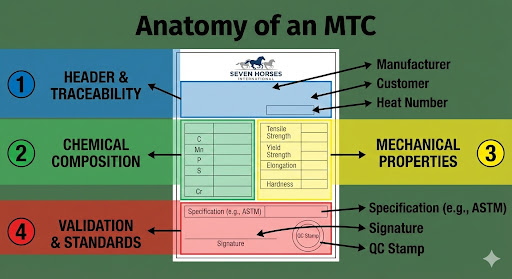
Let’s break down a typical fastener MTC into its four critical zones.
(Note: While layouts vary, these elements must be present.)
Zone 1: The Header & Traceability (The “Who & What”)
This section connects the paperwork to the physical product.
- Manufacturer: Who actually made the steel/fastener? (Not just the trader selling it).
- Customer/Consignee: Your company name should ideally be here.
- Product Description: E.g., “Hex Bolt M20 x 100mm, Grade 8.8”. Does this match your PO exactly?
- ⭐ CRITICAL: Heat Number / Cast Number: This is the DNA link. Every batch of molten steel has a unique ID. This number on the paper MUST match the number stamped on the product or its packaging. If it doesn’t match, the certificate is worthless for that product.
Zone 2: Chemical Composition (The “Recipe”)
This is the “ingredients list” of the steel, usually presented as percentages. Small changes here drastically alter performance.
- Carbon (C): The main hardener. More carbon usually means higher strength but lower ductility (more brittle).
- Manganese (Mn): Improves strength and toughness.
- Sulfur (S) & Phosphorus (P): Generally considered impurities. High quality steel keeps these very low (often <0.03%). Too much makes steel brittle and hard to weld.
- Chromium (Cr) / Nickel (Ni) / Molybdenum (Mo): The “expensive spices.” These are added for corrosion resistance (essential for stainless steel) and high-temperature strength (like in ASTM A193 B7 grades).
Action Tip: Compare these percentages against the standard (e.g., an ASTM or ISO spec sheet). If the standard requires minimum 16% Chromium for stainless 316, and the MTC shows 14%, reject it.
Zone 3: Mechanical Properties (The “Performance”)
This is what engineers care about most. It tells you how the material behaves under stress.
| Property | What it Means in Simple Terms | Why it Matters |
| Tensile Strength (Rm) | The maximum stress the material can take before it snaps. | Determines the ultimate load capacity. |
| Yield Strength (Re/Rp0.2) | The point where the material stretches permanently and won’t snap back. | Crucial for design—you never want to exceed this in operation. |
| Elongation (A%) | How much it stretches before breaking. | Indicates ductility. Low elongation means it’s brittle and might snap suddenly. |
| Hardness (HB/HRC) | Resistance to denting or scratching. | Important for wear resistance and verifying heat treatment. |
Zone 4: Validation & Standards
The final check.
- Specification: Does it clearly state adherence to the required standard (e.g., “Manufactured to DIN 931 / ISO 4014”)?
- Signature/Stamp: It must be signed by a qualified Quality Assurance representative from the mill. A digital signature is acceptable, but an unsigned document is just piece of paper.
Red Flags: How to Spot a Fake or “Lazy” MTC
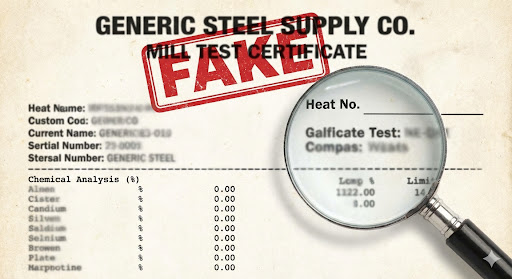
Unfortunately, fraudulent or doctored MTCs exist in the global market. When reviewing a document sent by a new supplier, look for these warning signs:
- The “Photocopy Effect”: The text is blurry, crooked, or looks like it has been faxed ten times. A real mill issues crisp digital PDFs.
- Missing Heat Numbers: The report offers “typical” results but doesn’t link to a specific production batch.
- Results That Are Too Perfect: Real manufacturing has variance. If the required minimum Tensile Strength is 800 MPa, and the MTC says exactly “800 MPa,” be suspicious. Real tests usually show results slightly above the minimum (e.g., 815, 822).
- Incorrect Units: Mixing up Imperial (ksi) and Metric (MPa) units in a way that doesn’t make sense.
The Seven Horses International Advantage: We Read It For You
We know that as a procurement manager or business owner, you don’t have time to become a metallurgist.
This is where Seven Horses International transforms from a supplier into a partner.
When you source fasteners and forged components from India through us, you aren’t just getting the product; you are getting a technical firewall.
- Pre-Shipment Audit: Our in-house technical team reviews the MTCs from our manufacturing partners before the goods are loaded onto the ship.
- Spec-Matching: We cross-reference the lab results against your specific drawing requirements and international standards (ASTM, DIN, ISO).
- Transparency: You receive clear, validated documentation that you can trust.
We take the guesswork out of global sourcing, ensuring that the “steel on the paper” matches the “steel in the box.”
Are you looking for a reliable partner for your next requirement of industrial fasteners or forged components from India?
[Contact Seven Horses International Today] for a quote, and experience the difference of working with a supplier who prioritizes technical integrity.